Overview
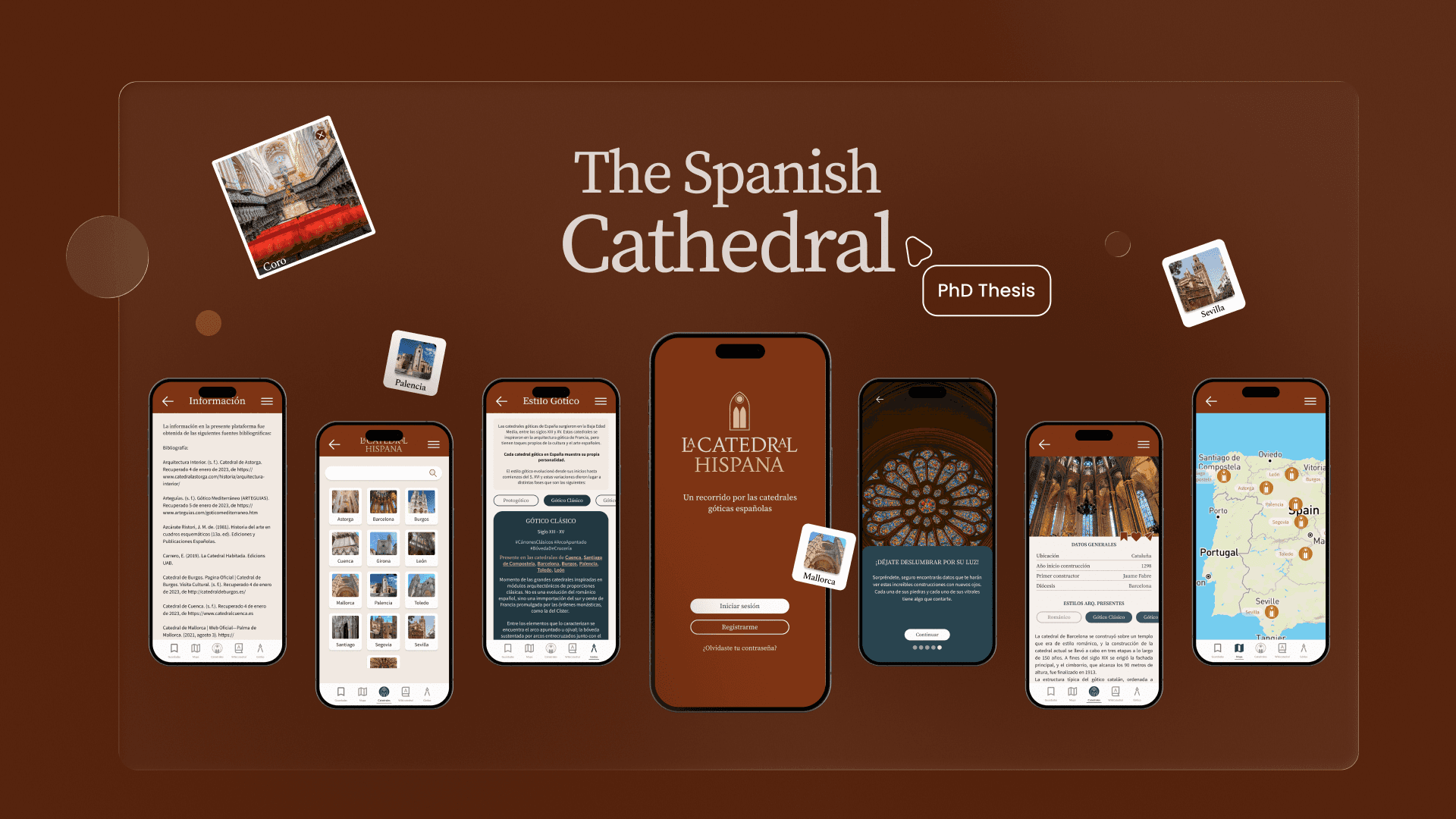
The Spanish Cathedral is a research and design project that proposes a digital and transmedia model for reinterpreting and disseminating Gothic heritage. Across 13 Spanish cathedrals, it connects historical architecture with contemporary audiences through accessible and coherent digital experiences, centered on the user from both a collective and individual perspective.
- Astorga
- Barcelona
- Burgos
- Cuenca
- Girona
- León
- Mallorca
- Palencia
- Toledo
- Santiago de Compostela
- Segovia
- Seville
- Valencia
My role and scope
This project was developed as part of my doctoral thesis, defended on October 30, 2025, with Cum Laude distinction.
My work focused on translating historical and academic content from the Late Medieval period into accessible and coherent information systems. I structured narratives, content architectures, and user journeys adapted to diverse audiences, platforms, and knowledge levels, consolidating a vision of design as a scalable narrative system where each channel serves a specific function within an integrated experience.
Impact
This project demonstrated how UX design can act as a rigorous methodology for heritage research, creating both academic and cultural impact.
- Translates historical-architectural knowledge into accessible and reusable digital formats.
- Unifies narrative and experience, breaking digital fragmentation across cathedrals.
- Validates UX design as a rigorous methodology for heritage research, generating publishable academic content (ACM Journal on Computing and Cultural Heritage, Volume 17, Issue 2).
- Demonstrates scalability: adaptable to multiple audiences (academics, tourists, students, children) and extensible to other Gothic cathedrals across Spain.
Discover The Spanish Cathedral
Problem statement
Despite their cultural and symbolic importance, Gothic cathedrals in Spain have rarely been approached through contemporary design and transmedia narrative frameworks. While many possess a digital presence, their content remains scattered, lacking a strategy that integrates architectural, historical, and experiential dimensions.
As audiences increasingly access culture through multiple formats and devices, there was a critical need to rethink how these heritage spaces communicate: in a current, accessible, and user-connected way.
Additionally, resources like audio guides have short lifespans and don't foster continuous learning.
Research and analysis
Research process
Research combined multiple inputs:
- User interviews and consultations with heritage and communication managers from each cathedral
- Analysis of current digital technologies available across cathedrals
- Contextual observation through in-person visits to each cathedral
- Comparative research of similar projects (transmedia and cultural interventions)
- Academic bibliography review on Gothic architecture and the Late Medieval period
In addition to the global research, I analyzed the current mobile applications of the cathedrals in the study. The table compares developers, formats, types of content, available technologies, and content focus.
| Cathedral | AST | BCN | BURG | CUEN | GIR | LEON | PM | PAL | TOL | STGO | SEG | SEV | VAL | |
|---|---|---|---|---|---|---|---|---|---|---|---|---|---|---|
| Developers | Artisplendore-Vocces | No | No | No | No | No | No | No | No | No | No | |||
| GVAM | No | No | No | No | No | No | No | No | No | |||||
| Other | No | No | No | No | No | No | No | No | No | No | ||||
| Format | Mobile app | No | No | No | No | No | No | |||||||
| Website | No | No | No | No | No | No | No | No | No | No | ||||
| Device | No | No | No | No | No | No | No | No | No | No | No | No | ||
| Tour type | Cultural | No | No | |||||||||||
| Reduced | No | No | No | No | No | No | No | No | No | No | No | |||
| Children | No | No | No | No | No | No | No | No | No | No | ||||
| Technology | Audio only | No | No | No | No | No | No | No | No | No | ||||
| Interactive map | No | No | No | No | No | No | No | |||||||
| VR/AR | No | No | No | No | No | No | No | No | No | No | No | No | ||
| Multimedia | No | No | No | No | No | |||||||||
| 360° visit | No | No | No | No | No | No | No | No | No | No | No | |||
| Content focus | Architectural | No | No | No | ||||||||||
| Artistic/Museum | No | No | No | No | ||||||||||
Developers
- Artisplendore-Vocces 3/13
- Astorga, Cuenca, Mallorca
- GVAM 4/13
- Barcelona, Palencia, Segovia, Valencia
- Other 3/13
- Girona, Toledo, Seville
Format
- Mobile app 7/13
- Barcelona, Burgos, Palencia, Toledo, Segovia, Seville, Valencia
- Website 3/13
- Astorga, Girona, Mallorca
- Device 1/13
- León
Tour type
- Cultural 11/13
- Astorga, Barcelona, Burgos, Cuenca, Girona, Mallorca, Palencia, Toledo, Santiago de Compostela, Segovia, Valencia
- Reduced 2/13
- Burgos, Cuenca
- Children 3/13
- Astorga, Girona, Valencia
Technology
- Audio only 4/13
- Astorga, León, Mallorca, Segovia
- Interactive map 6/13
- Barcelona, Burgos, Palencia, Toledo, Segovia, Valencia
- VR/AR 1/13
- Barcelona
- Multimedia 8/13
- Barcelona, Burgos, Cuenca, Palencia, Toledo, Santiago de Compostela, Segovia, Valencia
- 360° visit 2/13
- Astorga, Burgos
Content focus
- Architectural 10/13
- Astorga, Barcelona, Girona, León, Mallorca, Palencia, Toledo, Santiago de Compostela, Segovia, Valencia
- Artistic/Museum 9/13
- Astorga, Barcelona, Burgos, Cuenca, Mallorca, Palencia, Toledo, Segovia, Valencia
User personas
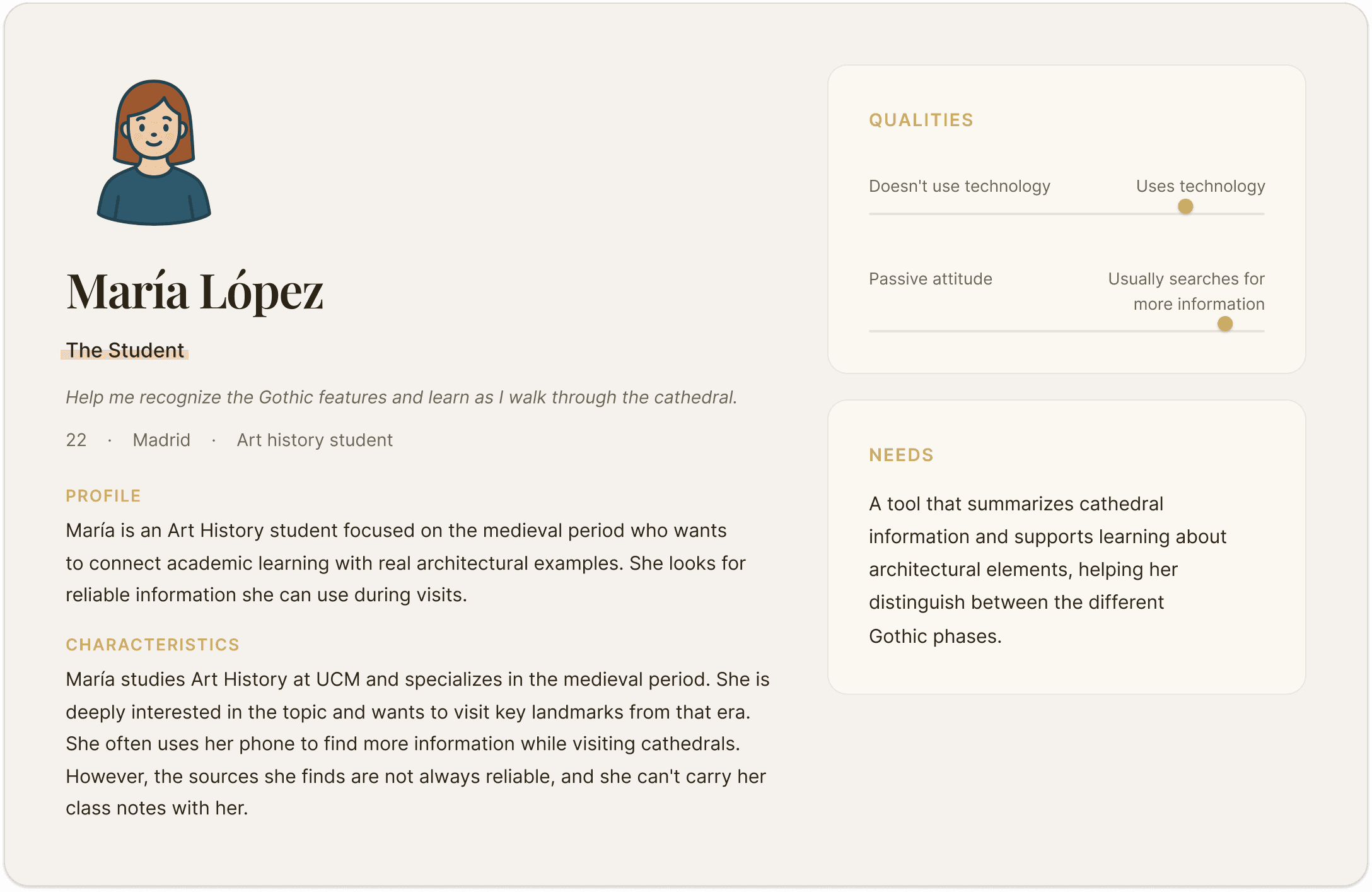
Three primary user profiles emerged, based on objectives and analysis:
Transmedia ecosystem
Design goals
The design objectives focused on facilitating access to heritage from a cultural rather than religious perspective. A clear and homogeneous information architecture was essential to break both the physical and temporal barriers that typically limit cathedral visits, and to:
- Translate academic content into language accessible to diverse audiences.
- Create a scalable, replicable transmedia cultural diffusion model.
The solution
The value lies not in the channel, but in the narrative and structural coherence across them. Designing heritage means designing systems of relationships between content, people, and contexts.
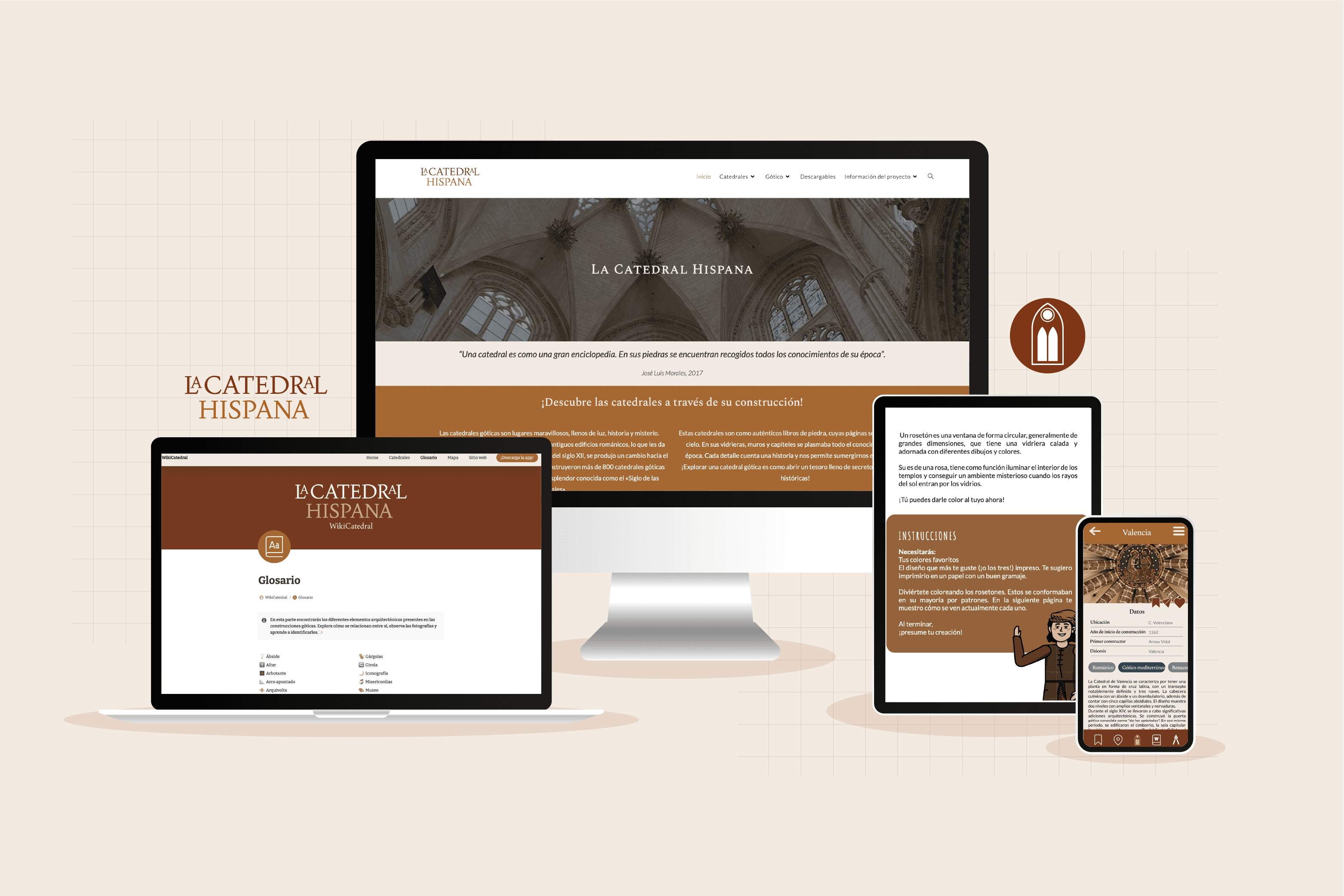
The project is conceived as an ecosystem of interconnected pieces, where each medium fulfills a specific role:
Website
Acts as the main entry point to the project and as a contextual space. Centralizes general information, presents the global narrative, and facilitates access to other platforms.
WikiCatedral
Through hypertext navigation, it allows deepening into concepts, architectural elements, and terminology, serving as support for both students and people with greater cultural interest.
Printed content
Editorial materials that act as a physical extension of the system, reinforcing on-site experiences and connecting digital layers with real architectural spaces.
 The Spanish Cathedral
Mobile app
Allows consulting cathedrals, identifying architectural elements, exploring different phases of the Gothic period, and personalizing the experience according to user interests.
For children
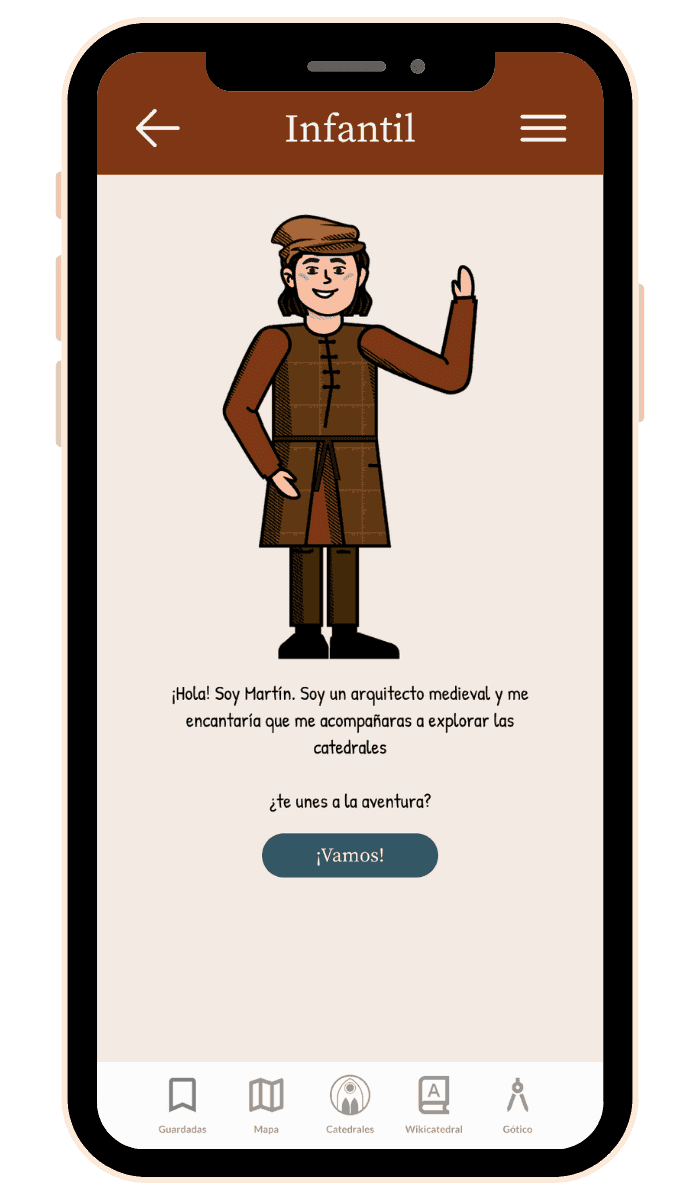
Designed to create early positive cultural experiences. Through narrative, illustration, and gamification, heritage concepts are translated into an accessible and participatory language.
Social media
Entry points to the ecosystem, activating curiosity, contextualizing content, and driving users toward deeper experiences.
Mobile app design
The mobile app is a cultural mediation tool designed to support access to and understanding of Gothic heritage in Spain. It allows users to locate Gothic cathedrals, explore general and architectural information, and identify key elements through structured, visual, and contextual content.
The app organizes knowledge around the different phases of Gothic architecture and offers multiple entry points encouraging dynamic navigation. Personalization features enable users to save points of interest and build their own cultural paths, adapting the experience to individual curiosity and knowledge levels.
Branding
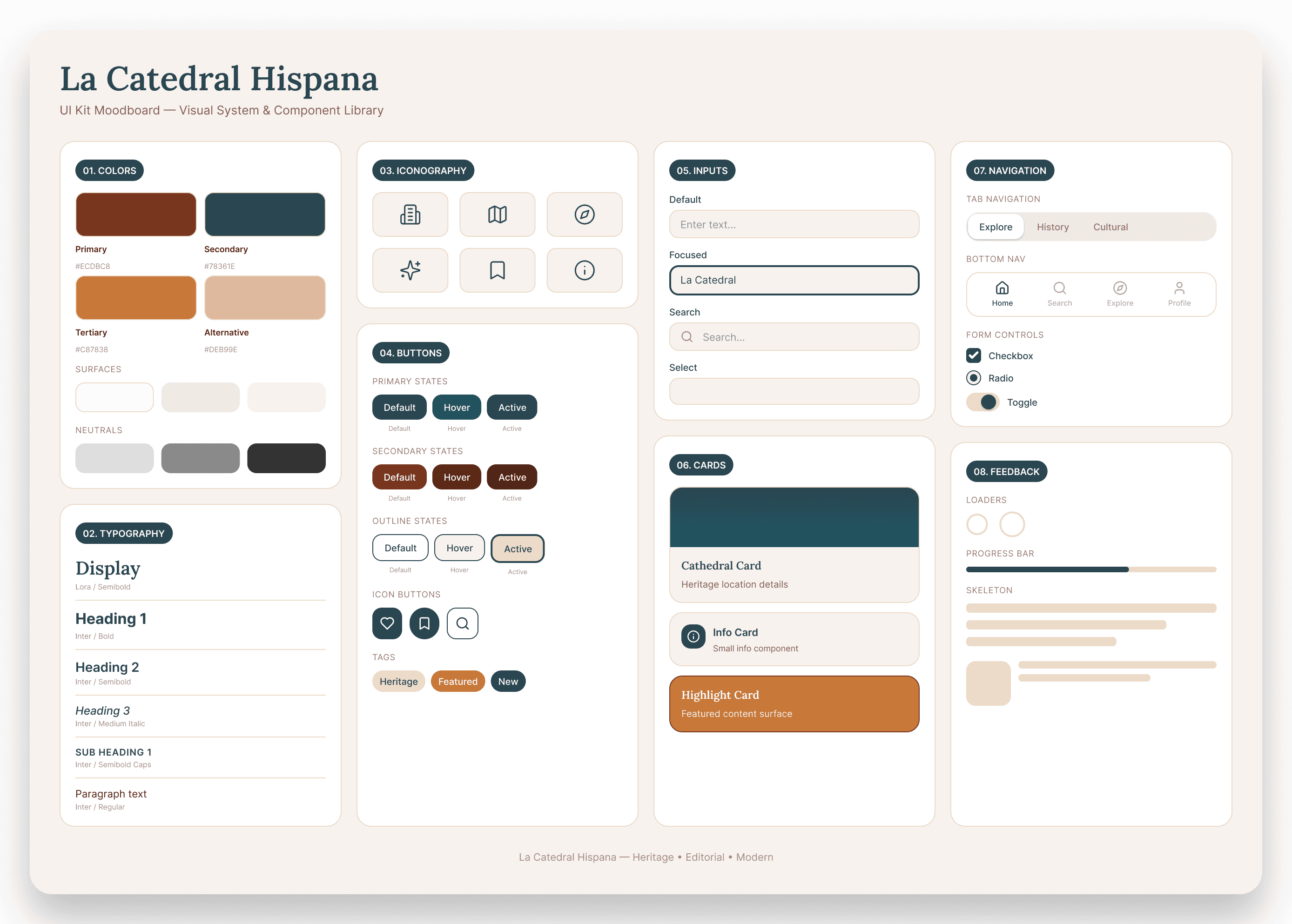
I designed The Spanish Cathedral logo by visually synthesizing key elements of Gothic architecture. The symbol abstracts a pointed arch with a rose window, reinterpreted through a geometric and contemporary lens to function as a cultural rather than strictly religious identifier. This approach preserves architectural meaning without literal representation.
The logo was developed in multiple variants (vertical, horizontal, and icon-only) to adapt to different contexts and scales across the transmedia ecosystem. The color system was defined using tones traditionally associated with religious and academic contexts.

- Brown#7E3616
- Terracotta#AF6424
- Sand#C9A88F
- Cream#F5EFE7
UI design
The interface design evolved into a reusable UI kit, created to ensure consistency and scalability across the mobile app and the website. The system includes components such as buttons, states, cards, lists, and navigation patterns, defined through hierarchy, readability, and accessibility principles.
Information architecture
Navigation is structured through multiple entry points: map, list, wiki, and Gothic phases. Hypertext relationships support progressive, non-linear learning.
- Tab bar
- Saved
- Map
- Cathedrals
- 13 cathedral pages
- Photo
- Data sheet
- Architectural styles
- Gothic elements
- Did you know…
- Official apps
- Cathedral museum
- 13 cathedral pages
- Wiki
- Gothic phases
- Gothic
- Mediterranean Gothic
- Atlantic Gothic
- Radiant Gothic
- Flamboyant Gothic
- Late Gothic
- Neo-Gothic
- Dropdown menu
- Profile
- Onboarding
- Links
- More info
- For kids
- Information
- Bibliography
- Credits
- Logout
Link External links
Register and onboarding
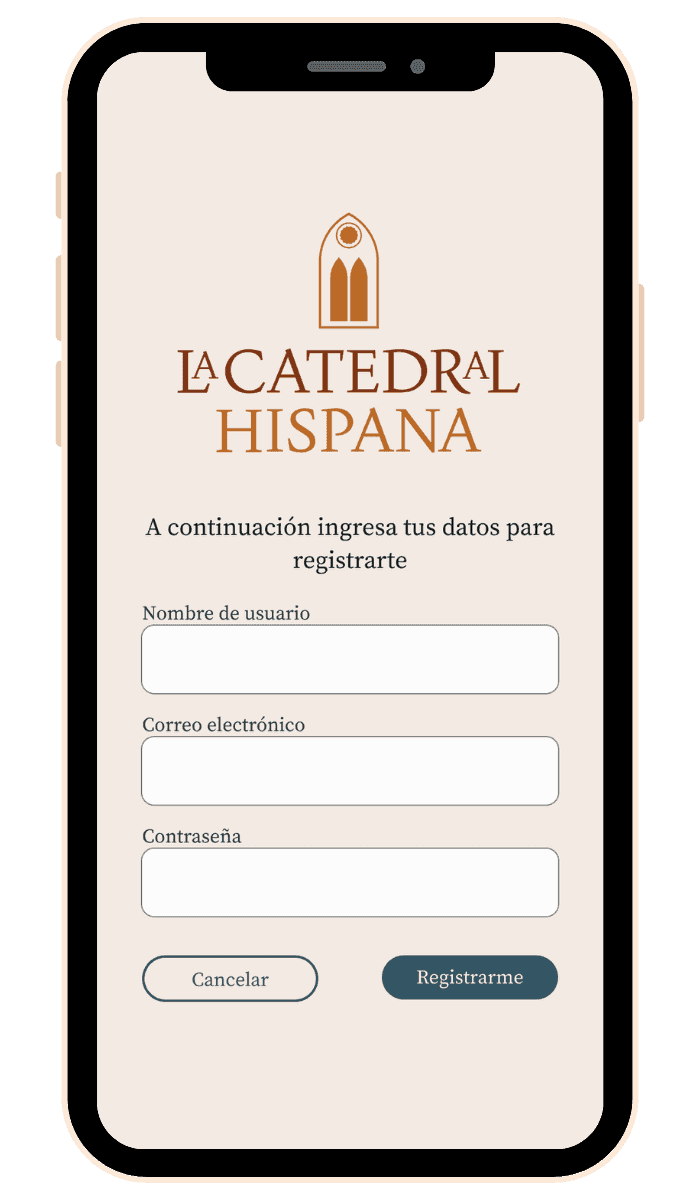
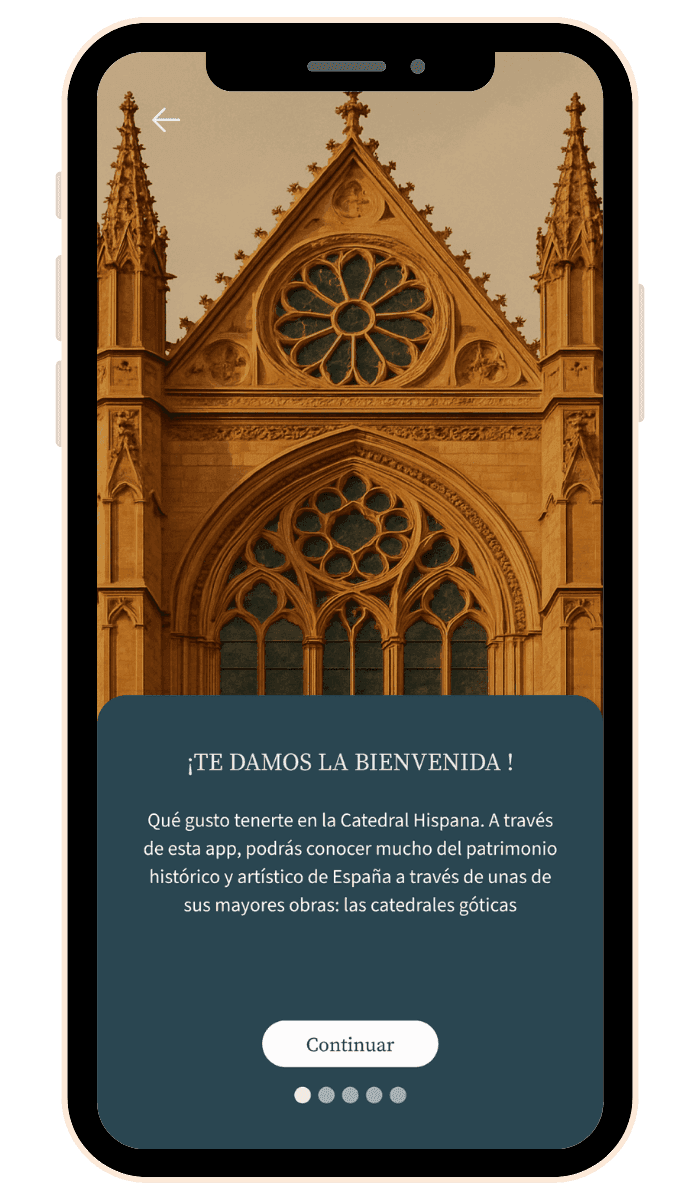
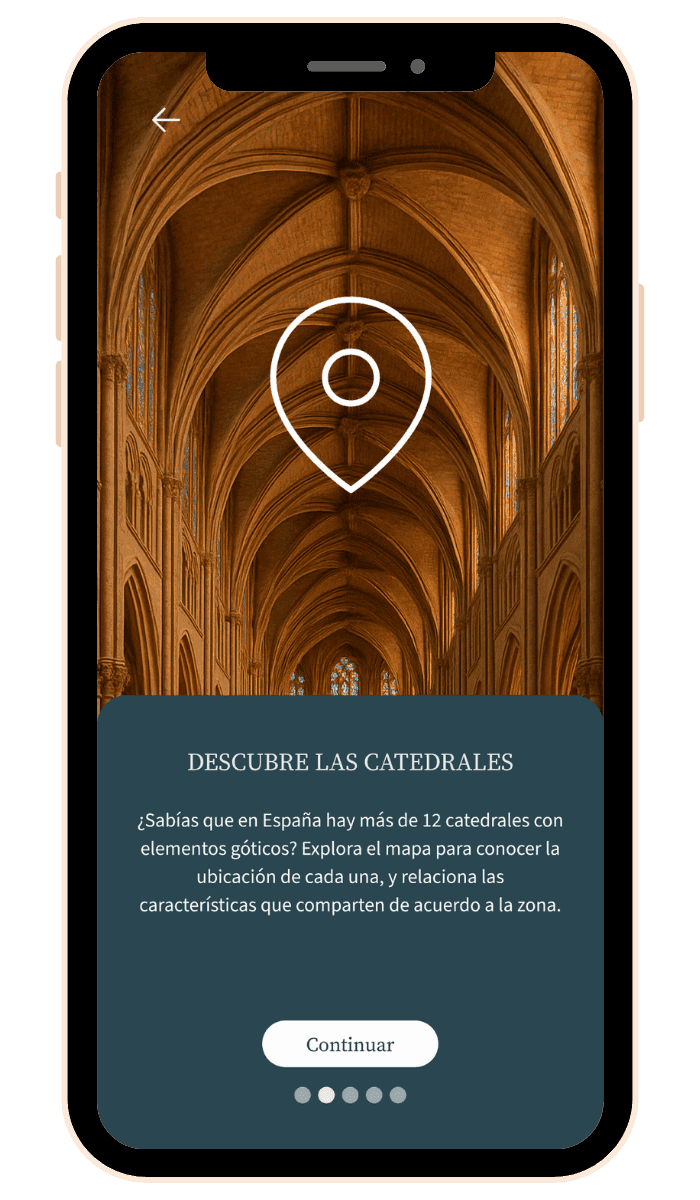
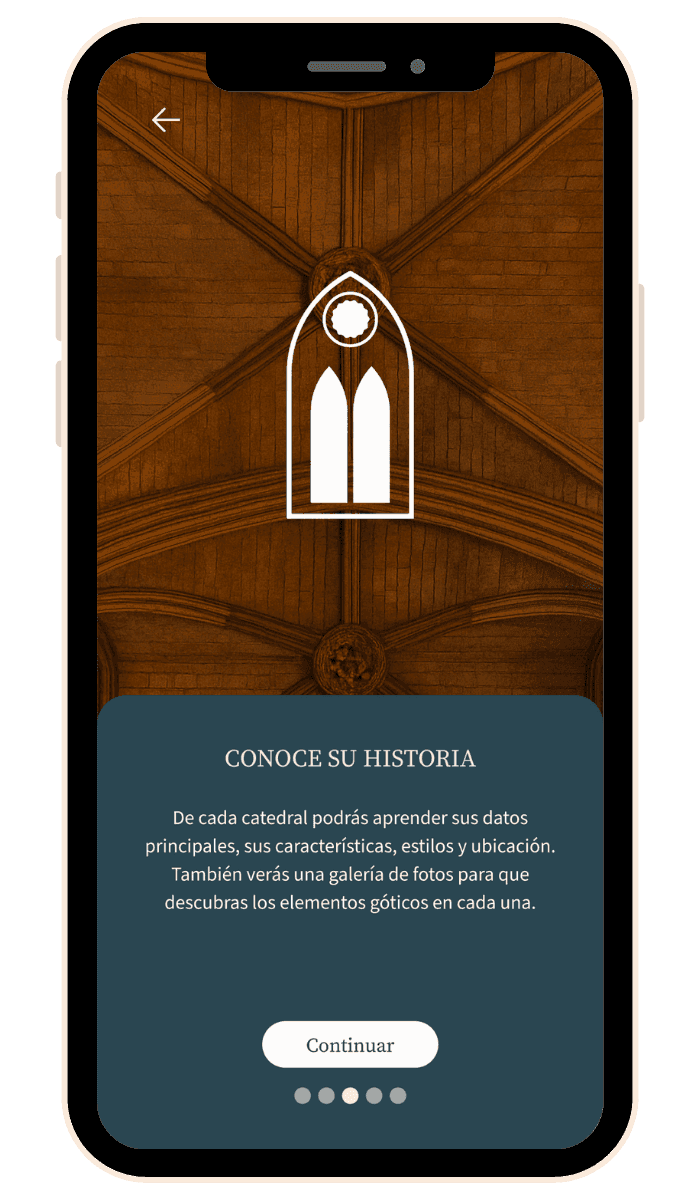
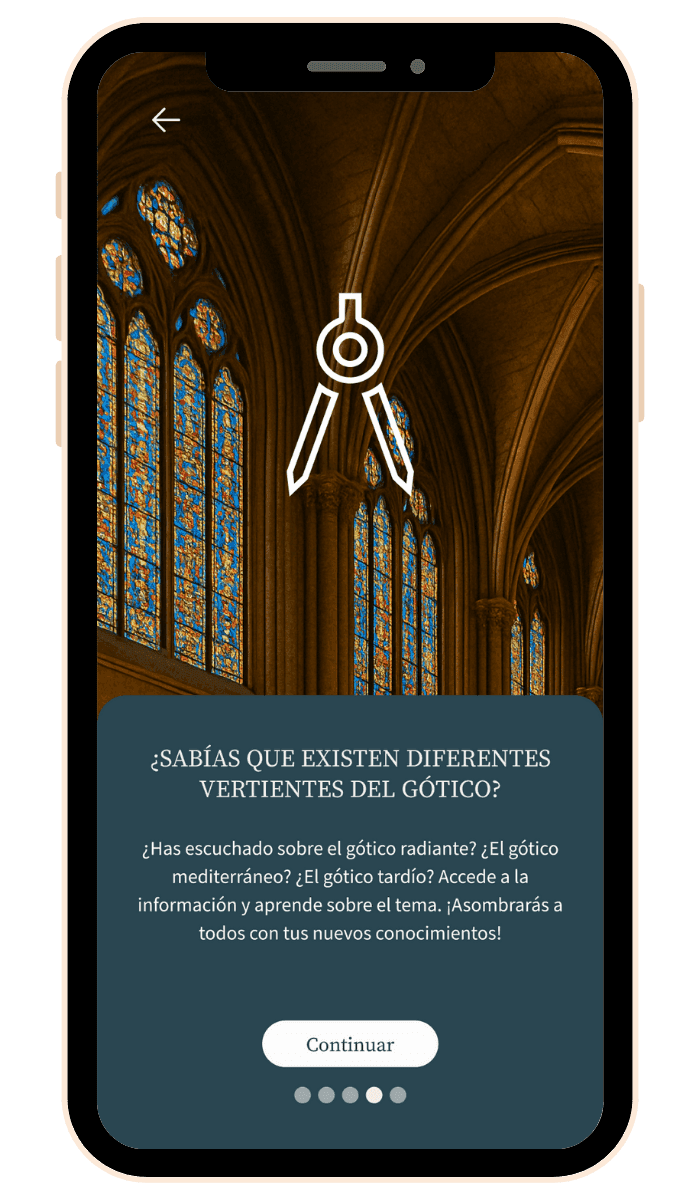
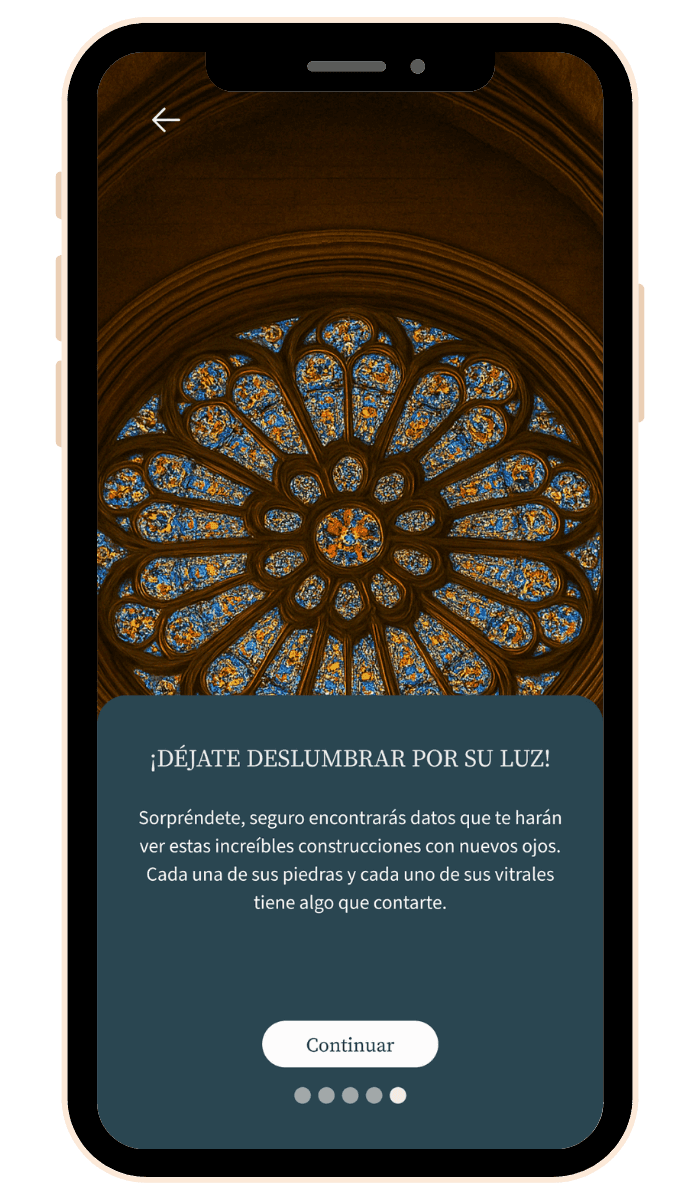
The onboarding flow is shown only once to avoid friction, but it remains accessible at any time through the hamburger menu. This approach balances initial guidance with user control, supporting gradual learning while respecting different levels of familiarity with Gothic heritage.
Main navigation
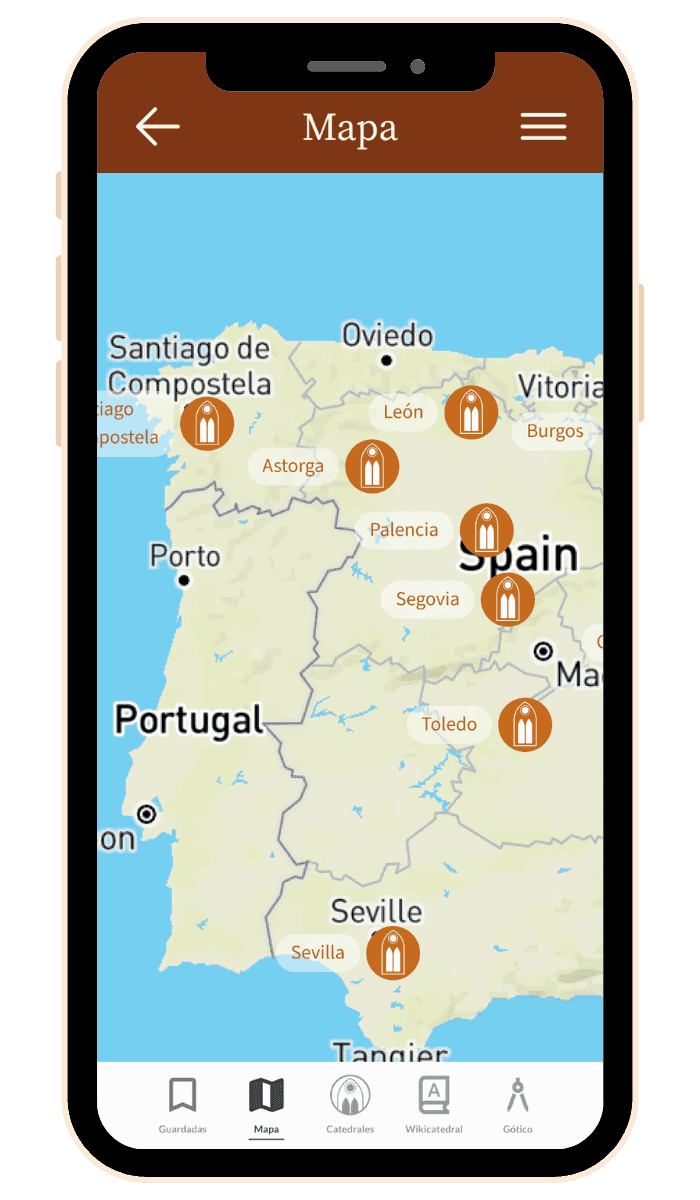
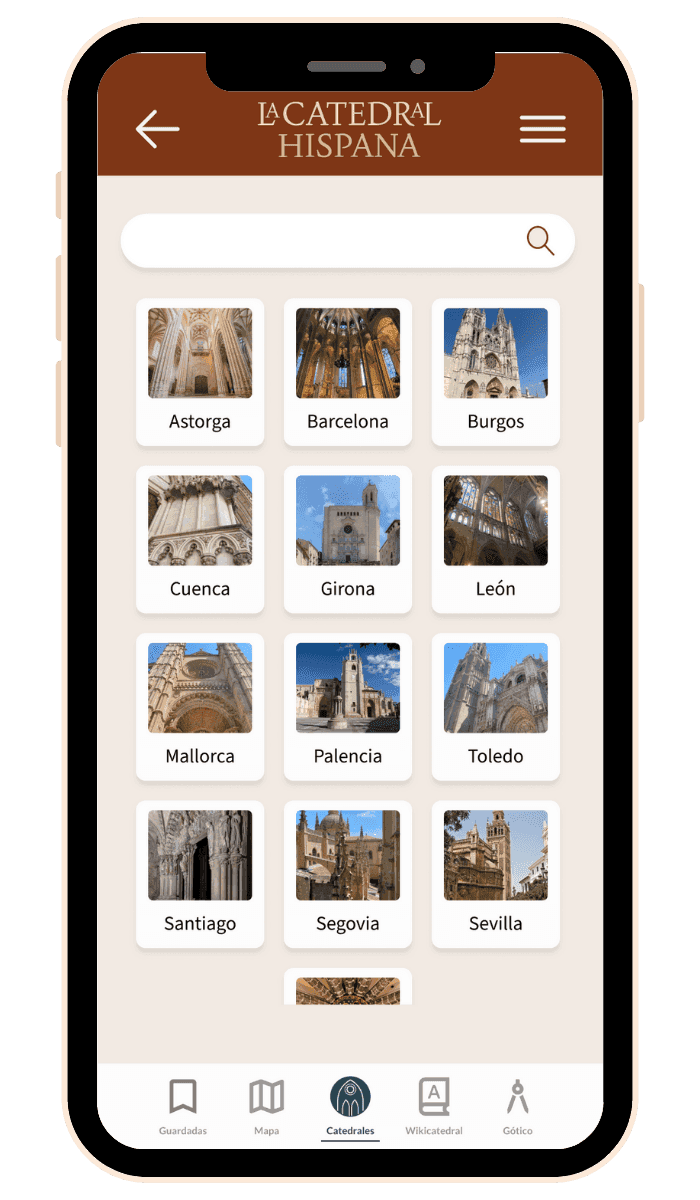
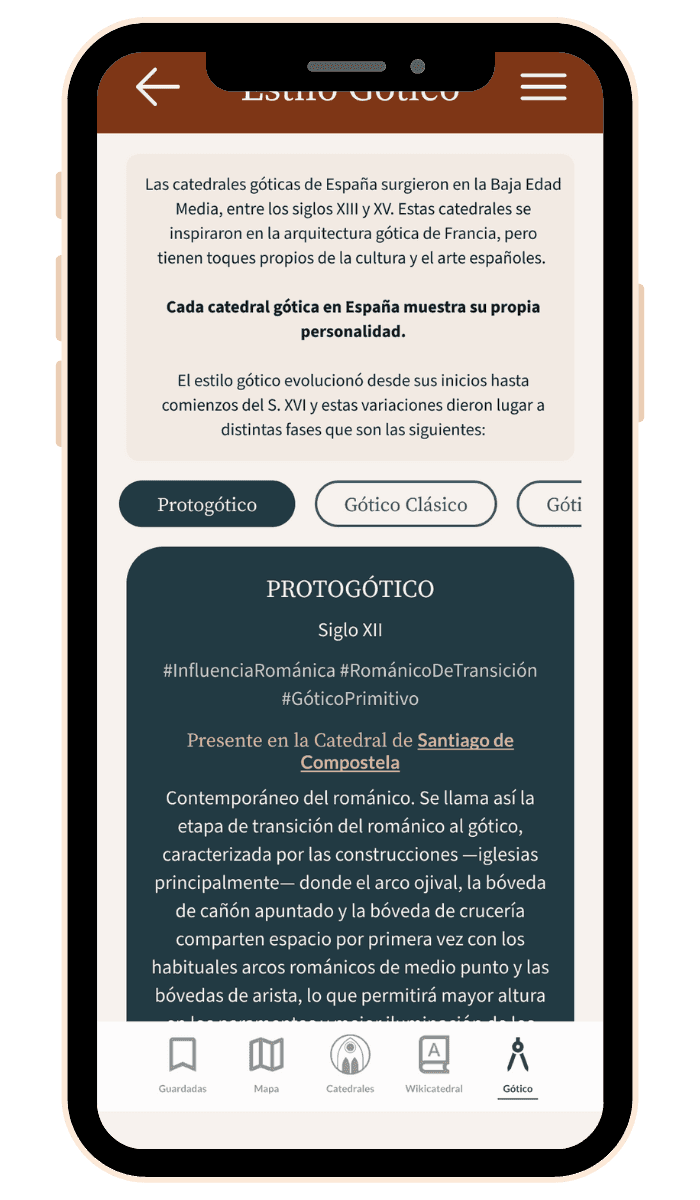
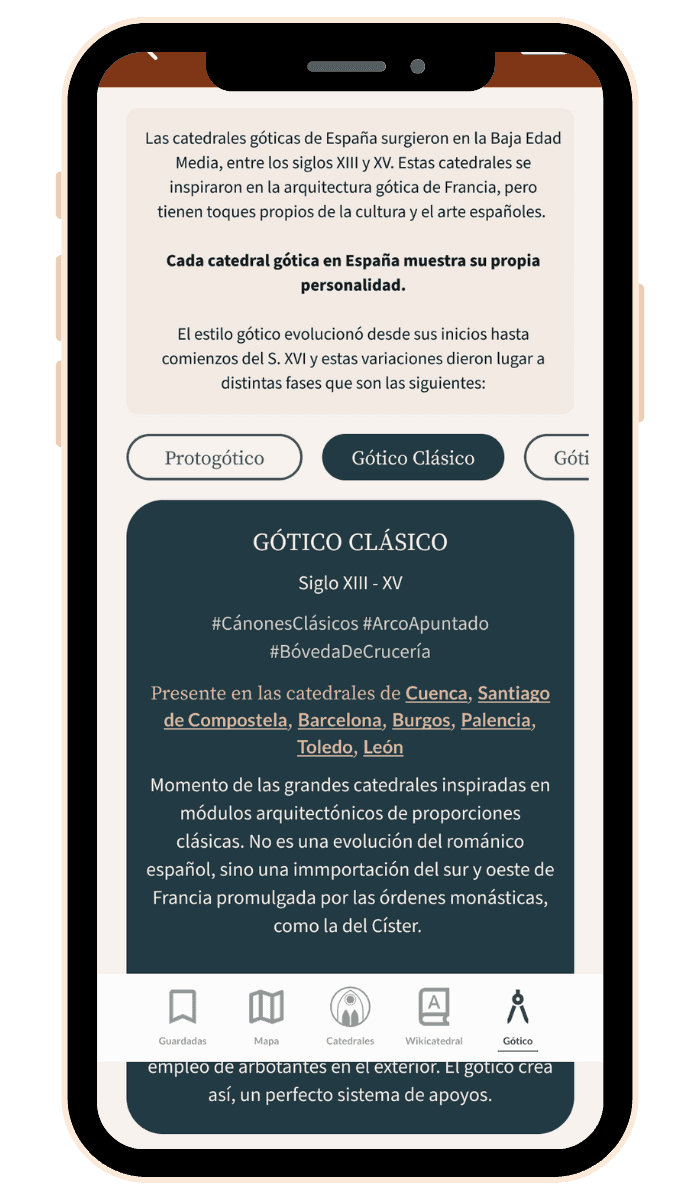
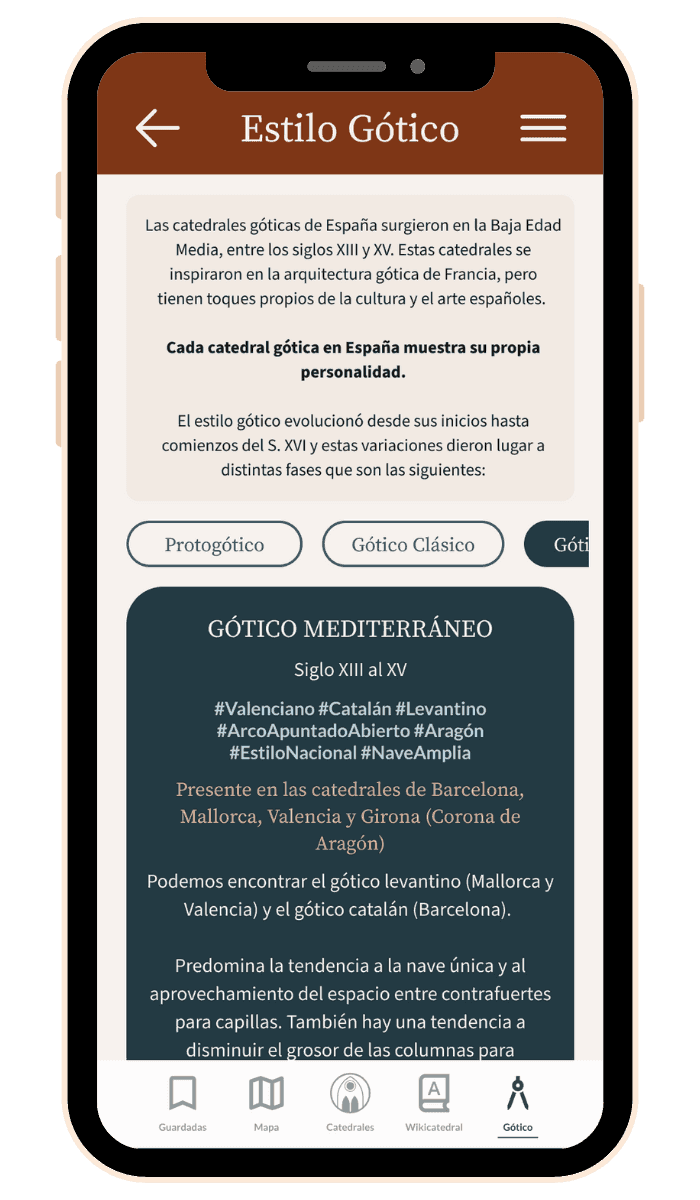
Navigation is structured through a bottom tab bar that provides direct access to the core sections of the app, allowing users to move freely between different modes of exploration:
- Map: explore the geographic location of Gothic cathedrals and access their information pages.
- Cathedrals: main entry point to browse and access detailed information about each cathedral.
- Wiki: external resource offering explanations of Gothic architectural elements and terminology.
- Gothic phases: tab-based navigation to explore and compare the different phases of Gothic architecture in Spain.
This structure was designed to support non-linear navigation, enabling users to build knowledge progressively according to their interests.
Cathedral detail view
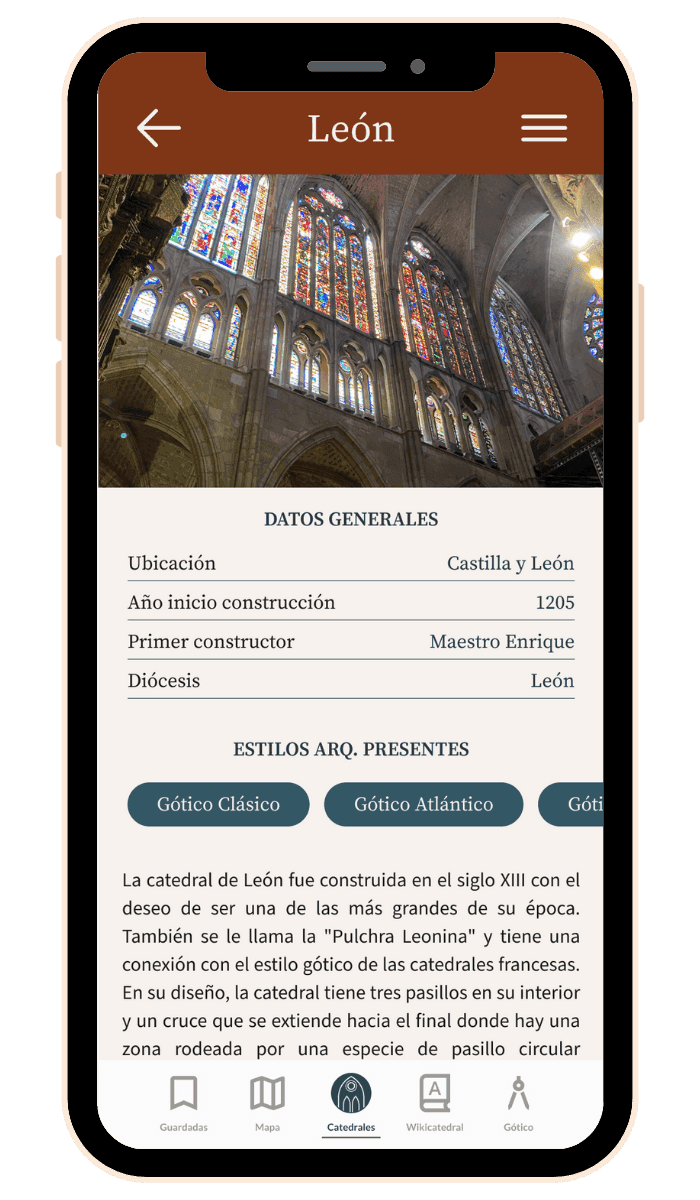
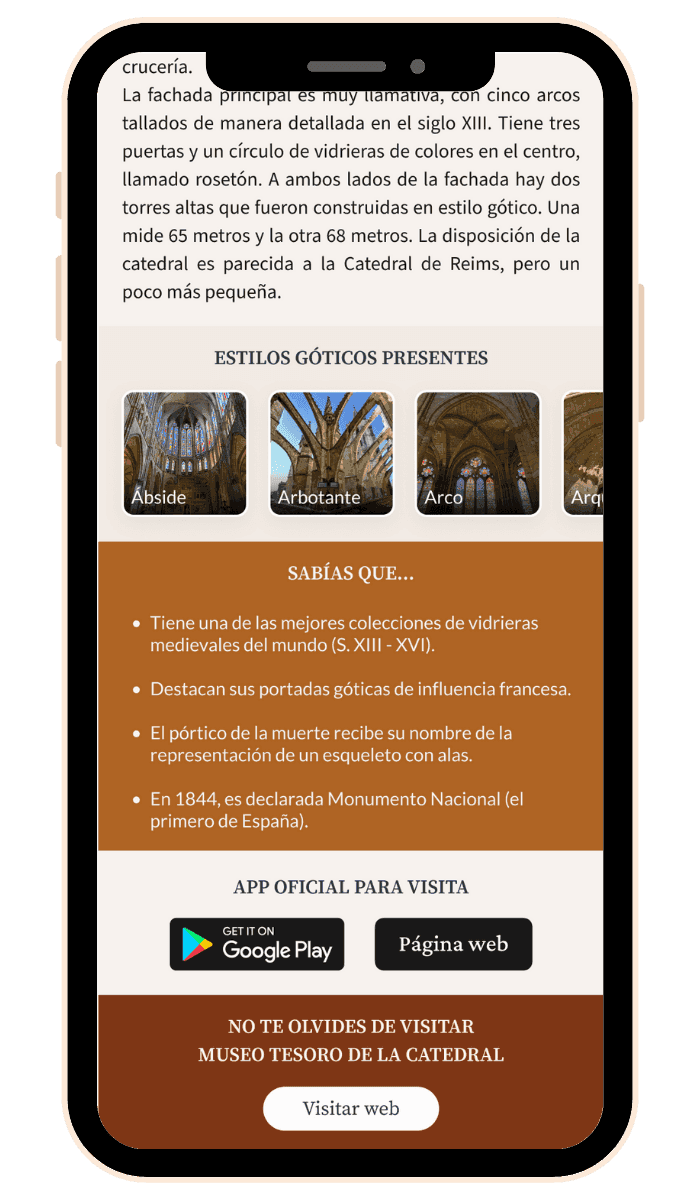
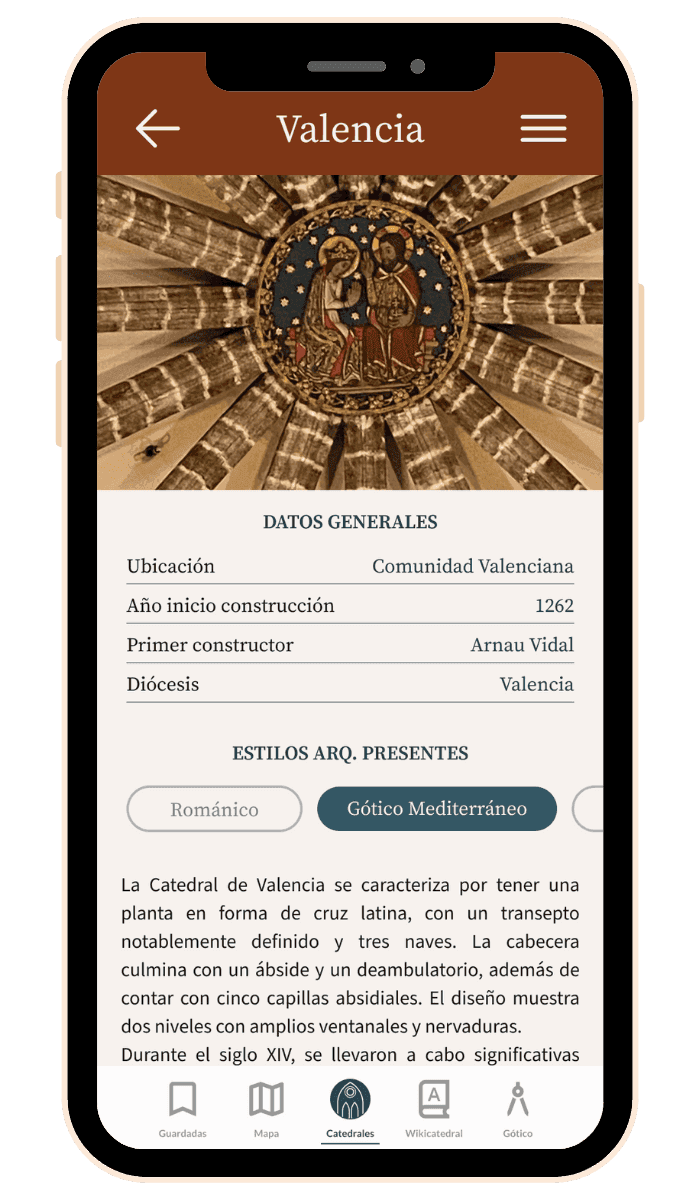
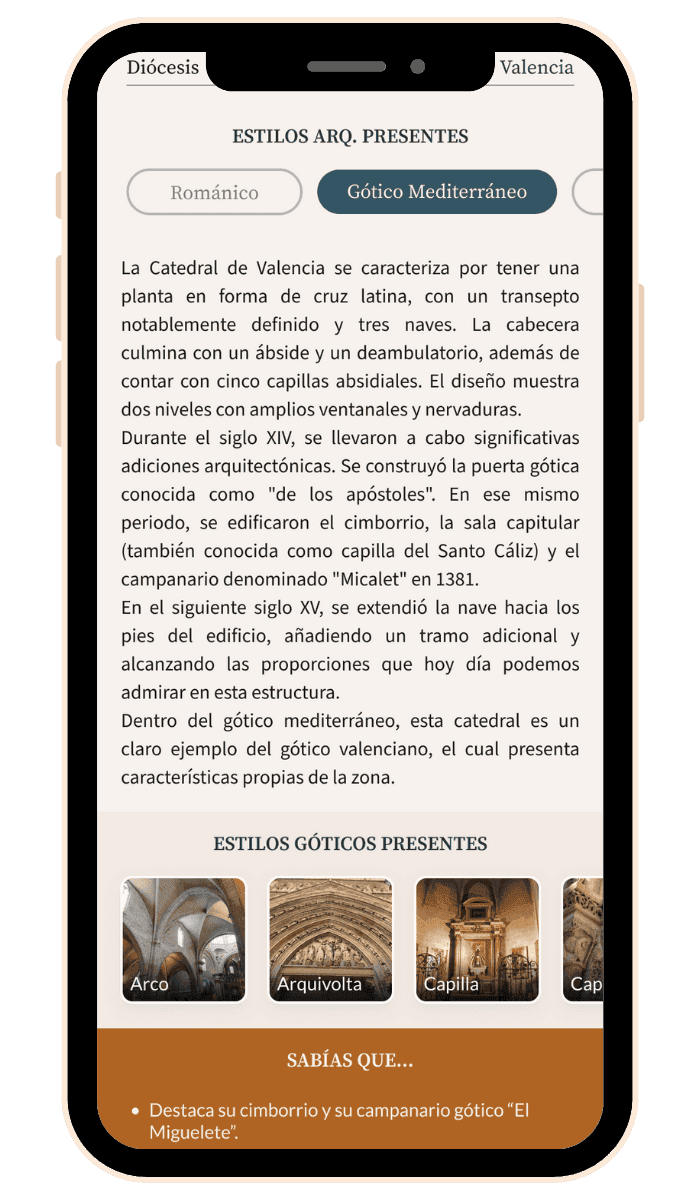
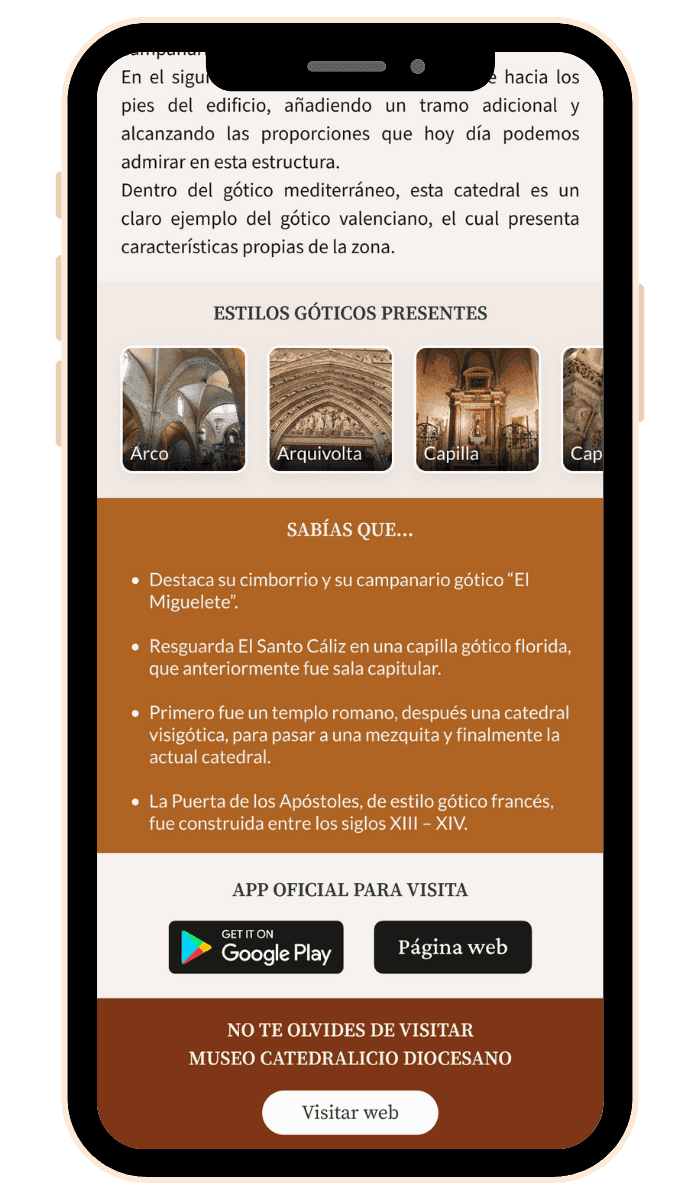
Each cathedral is presented through a dedicated detail screen that includes a technical overview, the Gothic phases represented in the building, descriptive content, an image gallery, and a "learn more" section for deeper exploration.
Content length and narrative structure were standardized across all cathedrals to ensure equal visibility and avoid hierarchical bias between sites. This decision reinforces the idea of the system as a shared cultural network rather than a collection of isolated landmarks.
Evaluation
The high-fidelity prototype was evaluated through heuristic walkthroughs and user testing sessions with representative profiles (cultural tourists and students). The goal was to validate content comprehension, navigation clarity, and the system's ability to support learning without increasing cognitive load.
Testing revealed friction points related to user support, content depth, and orientation within the system, highlighting the need for stronger guidance and contextual cues beyond visual design.
- 1Need for visible support and contact to build trust.
- 2Multilingual support as a structural requirement.
- 3Strong value of audiovisual content.
- 4Breadcrumbs to support progressive learning.
AI integration
A specialized GPT
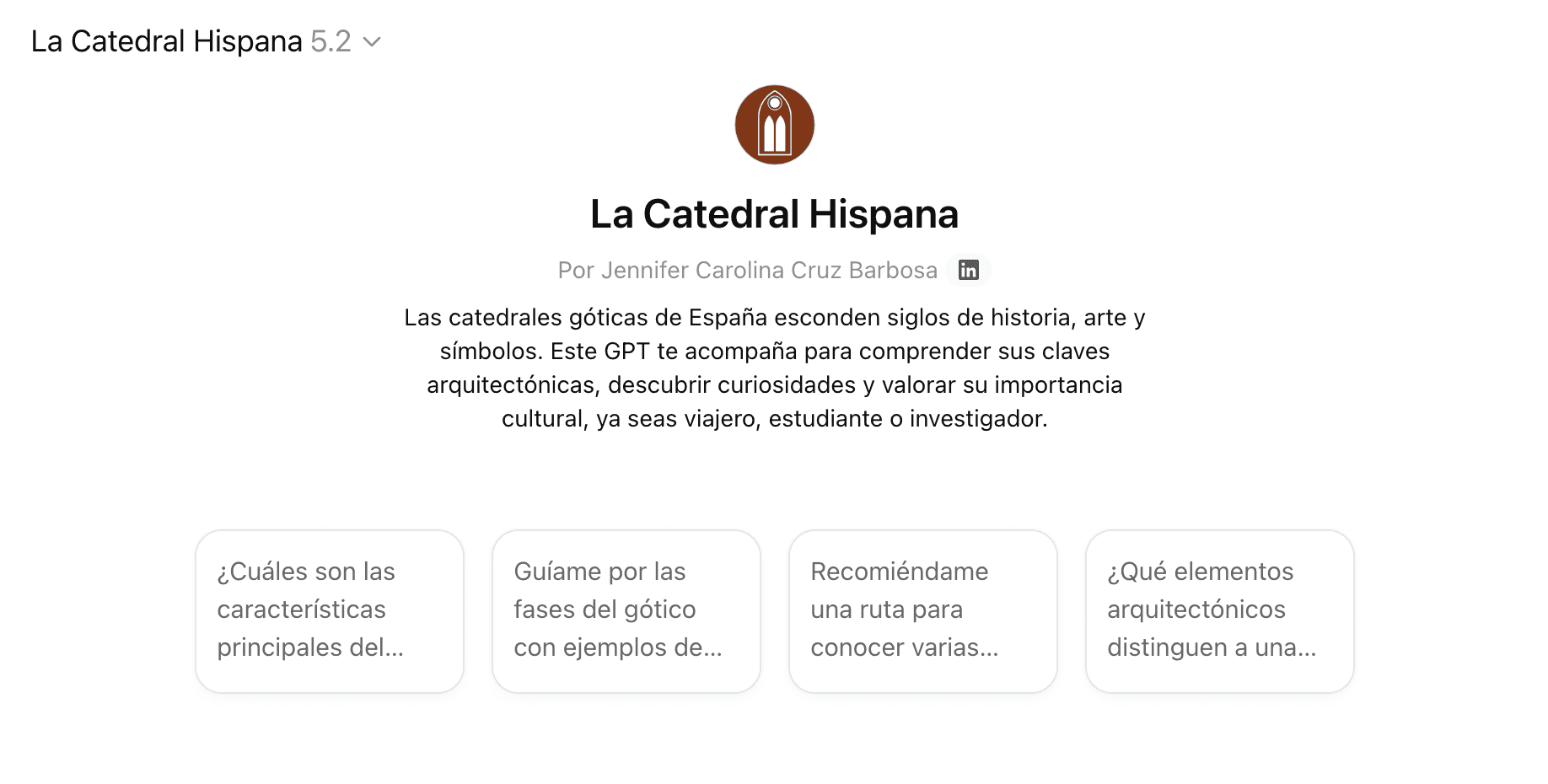
With the emergence of ChatGPT, I designed a specialized GPT as a natural extension of the ecosystem. The assistant complements existing content through conversational interaction.
The experience dynamically adapts to different user profiles (tourist, student, or academic) by adjusting tone, depth, and examples. From a UX perspective, I focused on Human–AI Interaction patterns grounded in clarity, explainability, and trust: explicit domain boundaries, contextualized responses using concrete examples, and polite refusals for off-topic queries.
This conversational layer supports autonomous learning, complements the system's content, and lays the foundation for future personalized and contextual experiences.
Educational and playful extensions
Martín, a narrative and educational mediator
Martín is a key character within the transmedia ecosystem, conceived to act as a connective element across the project's different digital touchpoints and experiences.
Rather than a purely visual asset, Martín operates as a mediator between heritage content and the user. He supports the understanding of complex concepts, ensures narrative continuity across channels, and enhances immersion within the project's universe, particularly in educational and children-focused contexts.
Game-based learning: a Monopoly adaptation
The project includes a Monopoly-based adaptation conceived as a playful extension of the transmedia ecosystem, using a widely familiar game mechanic to make heritage learning participatory and accessible. Instead of superficial gamification, the game's structure functions as a framework for exploration and discovery.
From a UX perspective, the board and its rules function as an action-based learning system: moving, deciding, repeating, and connecting concepts.
Learnings and next steps
This project confirmed that UX design can act as a strong bridge between academic research, cultural heritage, and technology, enabling complex knowledge to be translated into accessible, living systems. Designing from a system perspective rather than isolated products was key to maintaining coherence across channels and user profiles.
Thanks to the predefined information architecture, visual design, and content structure, the system supports progressive updates over time. Future iterations could incorporate additional Gothic Spanish cathedrals, such as Oviedo, Pamplona, Salamanca, or Ávila, without redesigning the core model.
Scalability and replicability
The Spanish Cathedral results in a replicable transmedia model for digital cultural heritage mediation. Beyond a single solution, the project functions as a methodological guide adaptable to cultural institutions seeking coherent experiences across physical and digital environments.
The model outlines a structured journey, from research to evaluation, integrating UX, information architecture, storytelling, gamification, and e-learning. This approach supports access, understanding, active participation, and long-term system sustainability.
Designing heritage is not about preserving the past, but about making knowledge inhabitable in the present.